
Seatbelts
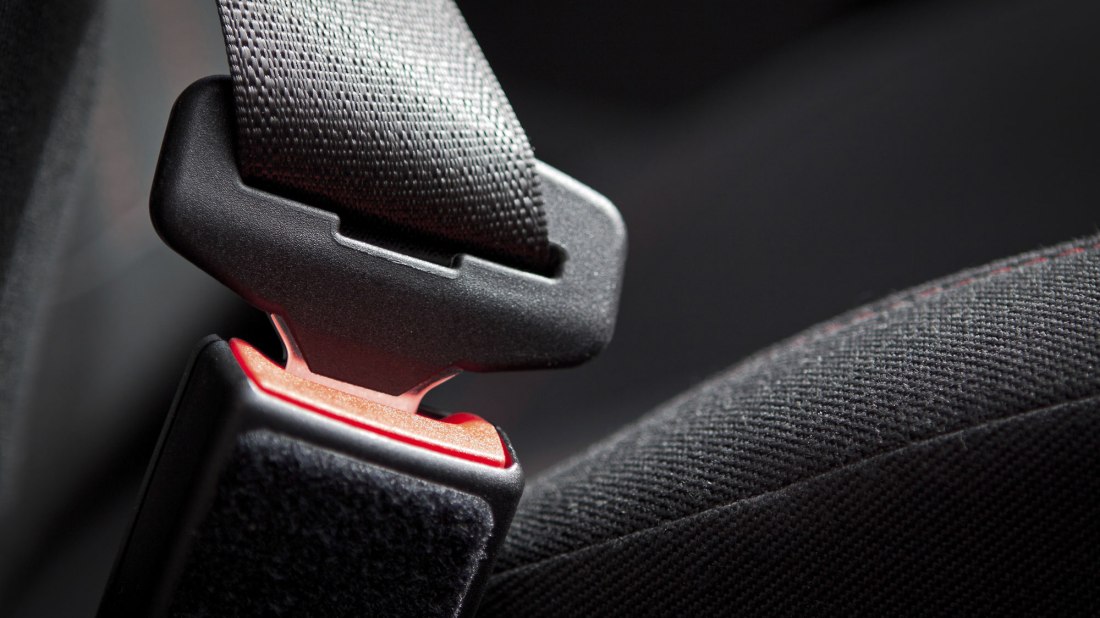
The seat belt is one of the best inventions for the car. The seat belt helps the passengers stay on the seat when a car stops. The reason why a person fly out of the car when they are not harnessed by a seat belt is that Newton’s first law explains objects in motion wants to stay in motion, objects that are still want to be still. Which is why when a car drives at a speed which then makes an immediate stop, the car might stop but the passengers that are not harnessed in fly out. This is where the seat belt comes in handy, the seat belt takes most the kinetic energy from the passenger which makes them stay still instead of flying out. This mechanism in the car helped save peoples live because they won’t fly out of the car when it makes an immediate stop. To find out how much force gets absorbed by the seat belt you must find out how fast the car is going and square it multiply that by negative half and multiplied by the mass and divided by the stopping distance.
F=(-1/2)(M)(V)^2/d
If an average weight of a male (80.7 kg) who is wearing a seat belt was driving at 100 km/h [Fwd] (27.7778 m/s) then makes an immediate stop. You can solve for the force that is absorbed by the seat belt. Seat belt stretches 1 meter.
F=((-1/2)(M)(V)^2)/d
F=((-1/2)(80.7)(27.7778)^2)/1
F=((-1/2)(80.7)(27.7778)^2)/1
F=-31134.3091/1
F=-31134.3091
F=31134.31 N [Bwd]
So the seat belt absorbs 31134.31 N in a situation where average male wearing a seat belt stops his car that is going 100 km/h. Now without a seat belt, this male would have gone through the windshield at 31134.31 N [Bwd].
Most seat belts also have a stretching factor which causes the impact to be a lot less compared to a non-stretching seat belt. This is because it gives more time for the passenger/driver to slow down a little bit before the seat belt stops you so you take less impact force from the seat belt. For example, if the seat belt stretched 2 m:
F=((-1/2)(M)(V)^2)/d
F=((-1/2)(80.7)(27.7778)^2)/2
F=((-1/2)(80.7)(27.7778)^2)/2
F=-31134.3091/2
F=-15567.15455
F=15567.15 N [Bwd]
Since the belt stretch two meters instead of one it halved the amount force you would take compared to 1-meter stretch factor. This creates less impact on the body when it hits the seat belt, which causes fewer injuries. The more a belt can stretch the less impact the passenger and/or driver will have to face. It also can stretch too much because if it does not stop you fast enough you will go hit your dashboard, steering wheel, windshield, etc.
It also depends on a person mass would affect the amount force you would have to face, a person with less mass like a child would have to face less impact force. For example, if a kid weighed 50 kg:
F=((-1/2)(M)(V)^2)/d
F=((-1/2)(50)(27.7778)^2)/2
F=-9645.0772
F=9645.08 N
So a 50 Kg child would face 9645.08 N if a car going 100 km/h stops immediately and has a stretchable seat belt that goes about 2 meters while an adult which we previously measured who weighs about 80.7 kg would face 15567.15 N in the same situation. Although a kid will face less force it is actually more dangerous for the kid since the amount force to break their bones is a lot less force compared to their adult counterpart because it is not as developed as it can be.
Airbags

Airbags are a quintessential safety mechanism that is in vehicles to keep the passenger/rider safe. Simply, airbags help decrease the passengers/riders overall momentum. This intern decreases the force the rider will feel because it will increase the time before the passenger will hit the steering wheel. Airbags itself aren’t the best safety measure to keep the rider safe but when it is combined with seatbelts it helps the rider be safe in a collision. When the airbags deploy in the vehicle and the rider finally hits the airbag, the airbag itself deflates slowly so the passenger doesn’t hit it and bounce back. Many vehicles now have a chip in them to measure how fast the vehicle is going so it can deploy the airbag fast enough relative to the speed the car is going. This chip also has a built-in accelerometer to help it calculate the time it should release the airbag.
The reason why airbags help the rider to not be as injured as they would be without airbags is that airbags help increase the time for the rider to feel the actual force. The time increased by airbags helps the momentum experienced by the rider reduce the force they will end up overall feeling, we know this because of the Momentum-Force equation.
(P represents momentum, F represents force, and T represents time)
F(T)=P (1)
F=P/T (2)
In equation (2) it can be seen that if time increases the number of force decreases if momentum stays constant which it most likely will in a car collision if anything momentum would most likely decrease which would only end up making the number even smaller. This is why airbags keep the passenger safe the more time it keeps us before we truly feel the actual force the less force we end up feeling, less force is fewer injuries.
For example, if a car is going 100km/h [Fwd] (27.7778 m/s) and the driver has a mass of 80.7 Kg, the vehicle collides with a wall and the airbags release and slows the driver for 4 seconds. To find the force:
(P represents momentum, F represents force, and T represents time, V represents velocity, M represents mass)
P=MV
P=(27.7778 m/s)(80.7 Kg)
P=2241.66846
P=2.24×10^3 Kg*m/s
F(T)=P
F(4)=2241.66846
F=2241.66846/4
f=560.417115
F=5.60×10^2 N
Now if the airbag was not existent the rider would feel(assuming it takes 0.5 seconds to reach the steering wheel):
F(T)=P
F(0.5)=2241.66846
F=2241.66846/(0.5)
F=4483.33692
F=4.48×10^3 N
This is why airbags are very useful because with those 4 seconds added because of the airbags it helped it cut down the force by a quarter (5.60×10^2 N) from the original momentum (2.24×10^3 Kg*m/s). Now without the airbag assuming the rider head will take 0.5 seconds to get to the steering wheel, the rider will feel 4.48×10^3 N of force, double the momentum. Even with the help of the airbags, the force is still pretty large this is why seatbelts are very useful because they help absorb the rest of the force and kinetic energy that the driver/passenger has.
Brakes
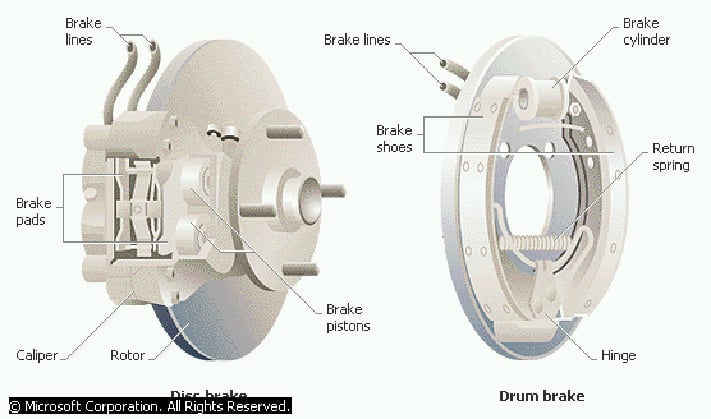
The brakes are one of the most important features to stop a car from moving. The brakes can be used to stop a car at a traffic light or stop it before it hits another car/obstacle. The brakes take all the kinetic energy of the car and change it into thermal energy, friction between the brake and the wheel. You can solve the amount of thermal energy created by knowing the mass and speed of the car.
EK represents kinetic energy, ET represents thermal energy, M represents mass, V represents velocity
EK=1/2(M)(V)^2
EK=ET
Obviously, EK=ET is not completely correct because the kinetic energy might have converted some of the energy into sound or/and hit a small object on the ground and gave it some of its kinetic energy or/and some of the energy lost through thermal energy with friction between the wheel and the road.
There are many major components in a brake system, some of the parts are the brake pedal, power-brake assist booster, brake lines, rotors, brake pads, master cylinder, brake line, brake fluid, etc… Parts like the hydraulic brake fluid must be changed over time because the brakes create a massive amount of thermal energy which wears down parts of the car mainly the brake fluid. This can be very dangerous because if it wears down the brake fluid the effectiveness of the brakes goes down which shows a clear problem.
The brake pads are very important in the braking system because that is the main reason why it stops the car because it creates the friction between the pad and the wheel. The pad clamps to the wheel because of the calipers that get affected by the brakes hydraulic system that uses the hydraulic brake fluid. The padding used has to not make a lot of noise, absorb a lot of heat, be effective, to not be worn down easily, and obviously cost efficient. Most cars use a ceramic substance that is lined with copper wires. The coefficient of friction between a metal and ceramic substance is 0.9.
FF is the force of friction, µK is the coefficient of kinetic friction, FN os normal force of the object
FF=(µK)(FN)
In a situation where a car is going at speed of 100km/h [Fwd] (27.7778 m/s) and the brakes are applied the car decelerates at a speed of 15.00 feet/s^2 (4.572 m/s^2)(this is the average amount a brake can stop a car according to nacto.org) and stops. Find the distance it covers before it stops.
Vf=0m/s
Vi=27.7778 m/s[fwd]
a=4.572m/s^2[bwd]
d=?
Vf^2= Vi^2+2ad
0=27.7778^2+2(-4.572)d
d=(27.7772*^2)/2(4.572)
d=84.39 m
This shows how even with the brakes a car can stop right away if it is going at 100km/h even if the setting favors the braking system(dry land since wetland would reduce the coefficient of friction). This is why cars on normal street roads(a road that is not a highway) the speed is a lot lower so they can easily stop at street lights.
Front Crumple Zone
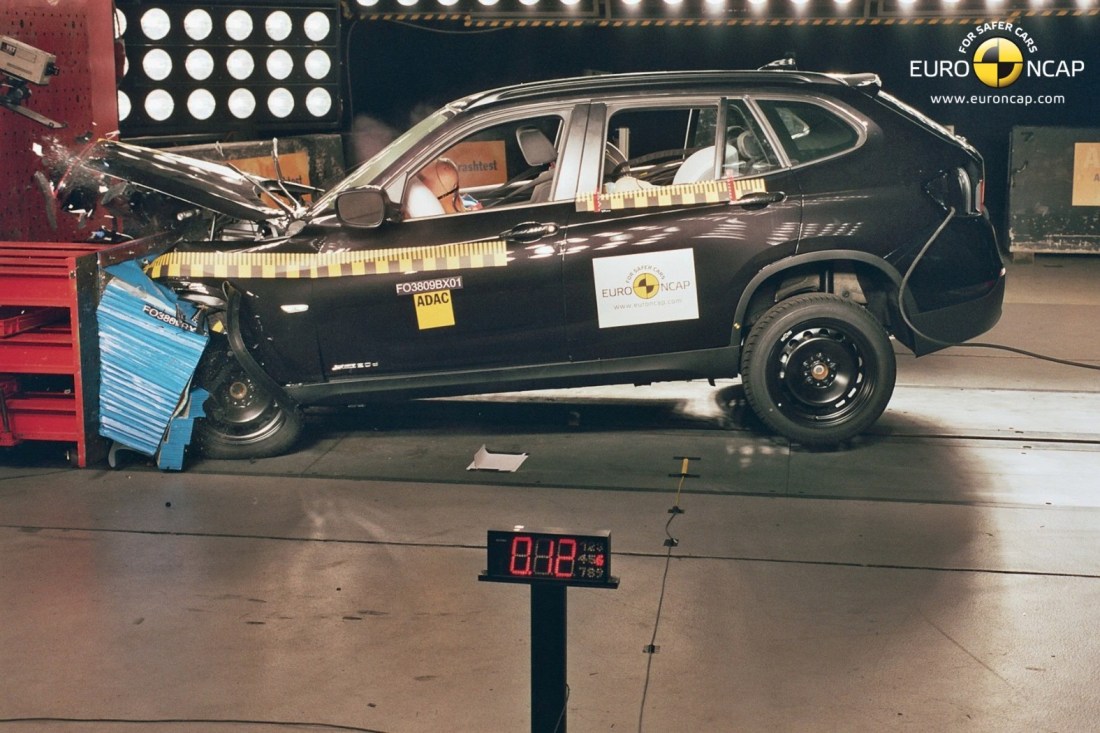
The crumple zone is one of they most undermined thing in a car for helping a person to survive a full fledge car crash. It is one of the most important things that keep the passenger alive in head on collisions through the idea of increasing time before the rider feels the real force of the crash. Many people undermine because it such a small thing to miss and feels like it shouldn’t do anything but in actuality it is one of the key parts for the rider and its passengers to survive the accident. The crumple zone differs for every car, depending on the mass, dimensions, heigh, amount it can hold, speed, acceleration, etc… all play key role on how big the crumple zone is for a car. Some engineers create a metal frame in the crumple zone so it can collapse on itself and absorb all the kinetic energy other scientist might used particular metals that have a property that allows them to absorb the energy a lot more efficentlly. The sight howstuffworks explains that many sports cars use a honeycomb design in their crumple zone so when it gets in a collision it collapses on itself which then absorbs a lot of the energy, in normal circumstance the honeycomb design is very strong but as soon its in a collision it collapses. The two main jobs for the crumple zone is to absorb a lot of the force so the rider and its passenger doesn’t feel it but also equal disperse the energy through out the hole system of the car so the humans in the car only feel a percentage of that force because it is equally dispressed. Crumple zones use non rigid material so it doesn’t crumple very quickly if this is true the car will slowly inevitably decelerate which we know it will decrease the force because (F=MA less acceleration less force, mass is constant in this situation). The whole idea is based to lose as much energy as quickly as it can so the occupants in the car don feel it for examples breaking glass (lose more energy), crushing the engine(lose more energy), bending the frame(lose more energy), bending the bumper which has springs(lose more energy), going through non rigid material(lose more energy) and etc… all these things are doing is one main task which is to lose energy quickly before the rider feels it. One major thing to note is that the whole car cant be a crumple zone, yes if the whole car was a crumple zone it would definitely absorb all of the energy of the car but one major leading downside to this is that the rider will also be crumpled because they have no study material protecting them from the easily crumble material, another problem to the idea of making the whole car a crumple zone is that their are many parts in a car that just cant crumple for example the solid engine that helps run our car these parts essentially cause the car to not be able have the status of being fully crumble.
here’s a video https://youtu.be/99Ts2ki50-I
 The Physics of Cars