
Engine
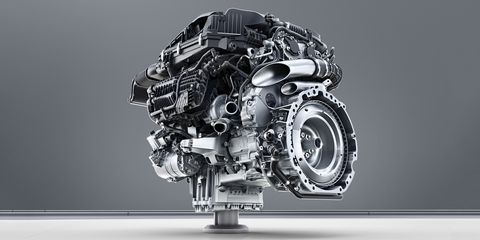
Essentially an engine uses the thermal energy from combusting the gas and use that energy to move the car. Engines are called an internal combustion engine this is because it takes the vapour from the gas that is put in by the driver and ignites it, when the gas burns it expands the air around it which will helps move the pistons to power the car. There is many parts in an engine, one part is the cylinder it’s a controlled valve that pushes the gas vapour and air into the engine. The crankshaft of an engine converts the up/down motion of the pistons into a circular motion. Engines also have areas to create good ventilation for the engine for both helping the combustion process but also the engine to not over heat.
Types Of Engines

One type of engine is a in-line engine they primarily made out of pistons that are place in a single file line. It is common to have 6 cylinders for such an engine.
The second type of engines is called a V-TYPE engine this name is given to it because of the shape the cylinders make which is a V, they are angled so that they are at least 90 degrees away from the other piston across from them. It is common to fit 8-12 cylinders, a lot more cylinders compared to a in-line. It is also a lot more compact and powerful compared to the in-line engine this is why a lot of sports car use this engine.
The third type of engine is a Horizontally-Opposed engine, like the V-TYPE engine the pistons are angled but unlike the V-TYPE engine(angle 90 degreess) the Horizontally-Opposed engine’s pistons are angled 180. This feature helps remove the massive vertical lenght an engine takes up and increases the overall balance of the car because the weight is more evenly distributed.
The engine primarly works by intake the gas mixture and compressing in the cylinder it is then ignited by a spark plug which drives the piston downwards, then the piston rises which compresses the new mixture of gas. This up and down motion is converted to circular motion by the crank shaft. While this is happening a valve called the exhaust valve opens to excrete the unnecessary substances in this process(carbon dioxide/ carbon monoxide) which goes through the exhaust pipe and then the outside world.
For the braking system(click here)(scroll down to find the barking system through the link)
Steering System
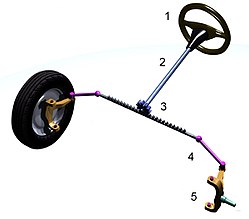
The steering system obviously helps the rider to be able to steer the car while its moving. In a summary it takes the motion of the steering wheel to move the axel of the wheel. It helps insure the rider to turn the car a massive distance with comparatively small rotations with the steering wheel, this causes the rider put little force to move the car which is very ergonomically for the driver. It moves the wheels by a series of joints that makes the suppression move up and down. This causes the joints to be very precise or else the steering could easily mess up.
Types Of Steering


One type of steering is the rack and pinion steering system. The steering wheel is connected to a universal joint which is connected to a rod that is attached to a (pinion). The grooves of the pinion is connected to a (rack), turning the steering wheel moves the pivot which moves the racks with usage of grooves which helps move the tires left and right.
The second type of steering system is a steering box system. A steering box has worm gear in it. The worm gear helps move the (rack) which again moves the wheels of the car. One major disadvantge of this system is that there is a lot of moving pieces which ends up wearing down the parts of the car causing them to need a lot of repairs, more often compared to the rack and pinion steering system.
The third type of steering system is a power assisted steering. Cars that has a heavy steering(could be because of mass or how low the car is) may use this system instead because it has a lock to lock system so the wheels don’t immediately turn back to the same position it was in. What happens is that the engine pushes the oil using pressure which is then given to the a rack/steering box. If the driver moved the wheel it opens the cylinder up for oil, the oil moves the car left or right with usage of the pistons. This system just helps heaveir vehicles to be driven if this system breaks down the car can be still turn it will just be harder because it will use a normal steering system.
Transmission
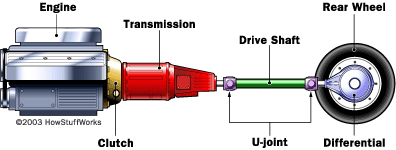
The transmission is a system that takes the engines power it produces to help rotate the wheel.
Rear Wheel Drive
If the car is rear wheel drive the engines power is transmitted through the gear box and then in to rear axel with the usage of a process called tubular propeller shaft. The axel also should have suspensions so it can waistband bounces from rough ground. To have constant movement the wheels have a universal joint, this allows to be flexible when continually give power to the wheels. These vehicles also have something called a differential, the differential helps create a process called “Final Drive”. The differential in summary helps cars to take sharper turns by making one of the real wheels to move faster.
Front Wheel Drive
The transmission has the same function as Rear wheel drive but has different layout depending on the gearbox and engine. Instead having a long shaft most front wheel/front engined cars are basically immediately connected to the axel instead having a long shaft connecting the two.
Suspension
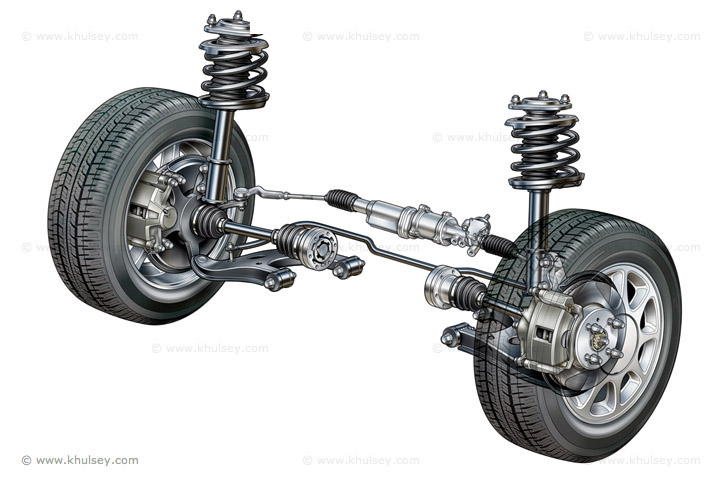
Suspensions are very important part of the car because the help absorb the impact shock the wheels feel so the rider doesn’t feel them and also help the car go over many rough terrain.
Non-Independent suspensions
The non-independent suspension is a part that connects the wheels using an internal frame this is where an elastic suspension part is connected which connects back to the main frame of the car.
Independent suspensions
The independent suspension uses the idea of connecting the wheels directly to the main body frame of the car instead of connecting the wheels through an axel. Each wheel has its on independent suspension.
Anti-roll bars
It is bar that can be at back or/and front of a car. It helps stop the car from rolling when it takes tight turns or massive bumps. Essentially it is a torsion bar that crosses through the car with pivots on either ends which are connected to the wheel. It essintally pulls a wheel up or down if the other wheels been pulled up or dow to keep the vehicle level.
 The Physics of Cars

